
SIP for 10 years, then stop: does your money keep growing?
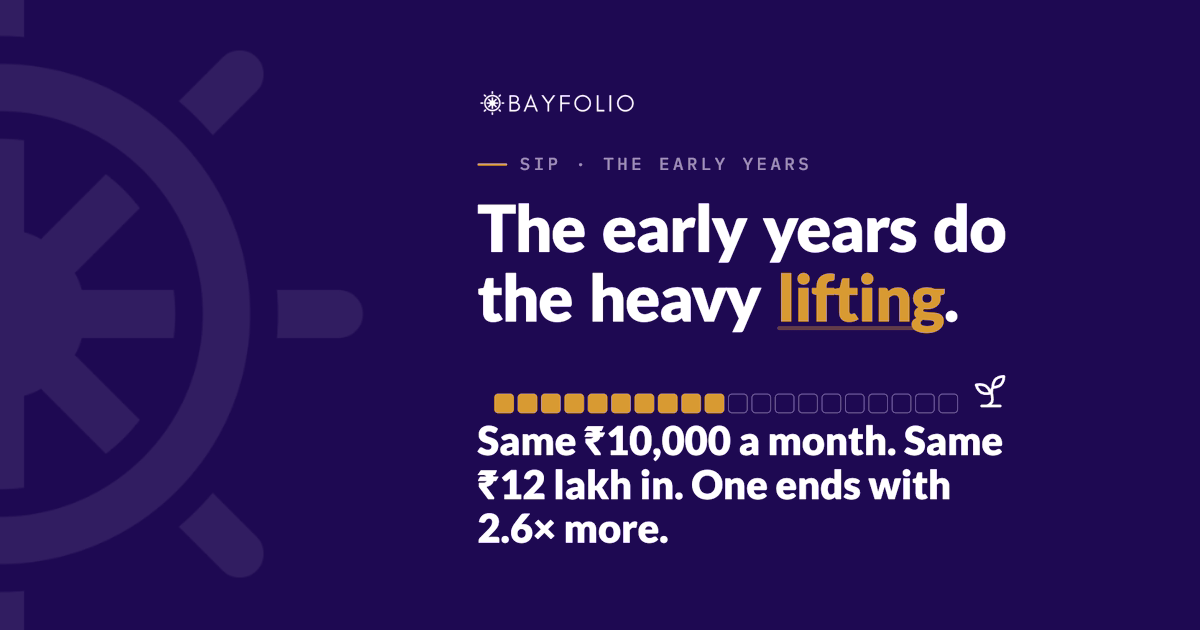
Compounding keeps working after you stop paying in. So if you can only invest for a few years, the early years count the most.
Three people, same ₹10,000 a month
We follow three people for the same 20 years:
- Mr. Early Bird pays for years 1–10, then lets the money sit. He puts in ₹12 lakh.
- Master Disciplined pays for all 20 years. He puts in ₹24 lakh.
- Ms. Slow Coach waits 10 years, then pays for years 11–20. She puts in ₹12 lakh.
What each one has after 20 years
An illustration at 10% a year:
| Investor | Money put in | Value after 20 years |
|---|---|---|
| Master Disciplined | ₹24 lakh | ₹72.4 lakh |
| Mr. Early Bird | ₹12 lakh | ₹52.3 lakh |
| Ms. Slow Coach | ₹12 lakh | ₹20.1 lakh |
Mr. Early Bird and Ms. Slow Coach put in the same money. Mr. Early Bird ends with about 2.6 times more. His money had 10 more years to grow.
Does it hold on real market data?
Yes. We tested all 88 twenty-year periods of the Nifty 50 (with dividends) from 1999 to 2026.
- Mr. Early Bird ended ahead of Ms. Slow Coach in all 88 periods.
- Mr. Early Bird ended with 75–82% of Master Disciplined's money, with half the instalments.
- Ms. Slow Coach ended with 18–25%.
These are index returns, not fund returns. They leave out costs and tax.
The honest part
This is not a reason to stop a SIP.
- Master Disciplined ended with the most money, every time. If you can keep going, keep going.
- Real returns jump around. 10% a year is only an illustration.
- If your window to invest is short, use it early: before school fees, a home loan or a career break.
Questions people ask
If I stop my SIP after 10 years, does my money keep growing?
Is it better to invest early for 10 years or late for 10 years?
Should I stop my SIP after 10 years, then?
What return does this assume?
Start early. Let time finish the job.
If you can keep a SIP going, keep going. If your window is short, make the early years count.
Illustration at an assumed 10% a year, compounded monthly. Not a promise of returns. Real-data check: NSE Nifty 50 Total Return Index, month-end closes, June 1999 to September 2026. Index returns, not fund returns. No costs or tax.
Mutual fund investments are subject to market risks. Read all scheme-related documents carefully. Past performance does not guarantee future returns. BayFolio LLP · AMFI-registered Mutual Fund Distributor · ARN-363035.
Member discussion