
How much does your FD really earn after tax? FD vs arbitrage fund
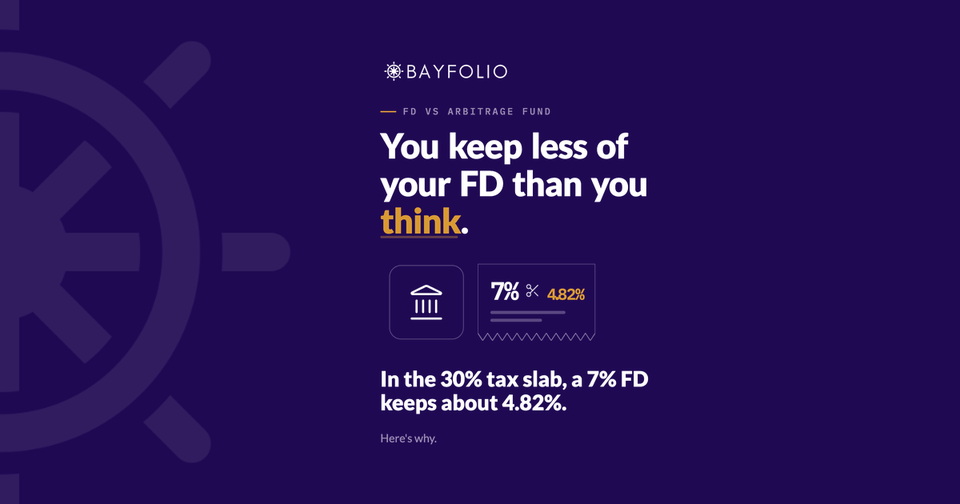
A 7% FD sounds simple. But you do not keep 7%.
FD interest is taxed every year, at your slab
FD interest is added to your income. It is taxed at your slab rate, every year, even if you do not withdraw it.
In the 30% slab, add the 4% cess and the tax is 31.2%:
| Rate | |
|---|---|
| FD interest | 7.00% |
| Tax at 31.2% | −2.18% |
| What you keep | about 4.82% |
An arbitrage fund is taxed differently
An arbitrage fund carries similar low risk. It is taxed like equity, and only when you sell. Never at your slab.
- Sold within 12 months: 20% on the gain.
- Held over 12 months: 12.5% on gains above ₹1.25 lakh a year. That ₹1.25 lakh is one limit shared across all your equity gains in the year.
- Cess applies on top.
Side by side
| Fixed deposit | Arbitrage fund | |
|---|---|---|
| Tax rate | Your slab (up to 30%) | 20% or 12.5% (equity rules) |
| When taxed | Every year | Only when you sell |
| TDS | 10% once bank interest crosses ₹50,000 a year (₹1 lakh for senior citizens) | No TDS on redemption for resident individuals |
| Return | Fixed | Moves with market conditions |
TDS is a prepayment of tax, not the final tax. Your tax return settles the total.
The honest part
The FD can still be the right choice:
- When you need a guaranteed return and capital you cannot afford to lose.
- When you are in a low tax slab. Then the gap shrinks a lot.
And arbitrage returns are not fixed. They change with market conditions.
Questions people ask
How much does a 7% FD earn after tax in the 30% slab?
How are arbitrage funds taxed?
Is there TDS on mutual fund redemption for residents?
When is an FD better than an arbitrage fund?
Know what you actually keep
Compare returns after tax, not before. The headline rate is not what reaches your pocket.
Illustration for a resident individual in the 30% slab (new regime: income above ₹24 lakh), tax year 2026-27; 4% cess; no surcharge assumed (applies above ₹50 lakh income). Arbitrage funds are equity-oriented: gains on units held 12 months or less taxed at 20%; over 12 months, 12.5% on gains above ₹1.25 lakh a year (one limit shared across all listed equity gains); plus cess. Returns are not guaranteed.
Mutual fund investments are subject to market risks. Read all scheme-related documents carefully. Past performance does not guarantee future returns. BayFolio LLP · AMFI-registered Mutual Fund Distributor · ARN-363035.
Member discussion