
NRI monthly income from mutual funds: IDCW or SWP? How TDS differs
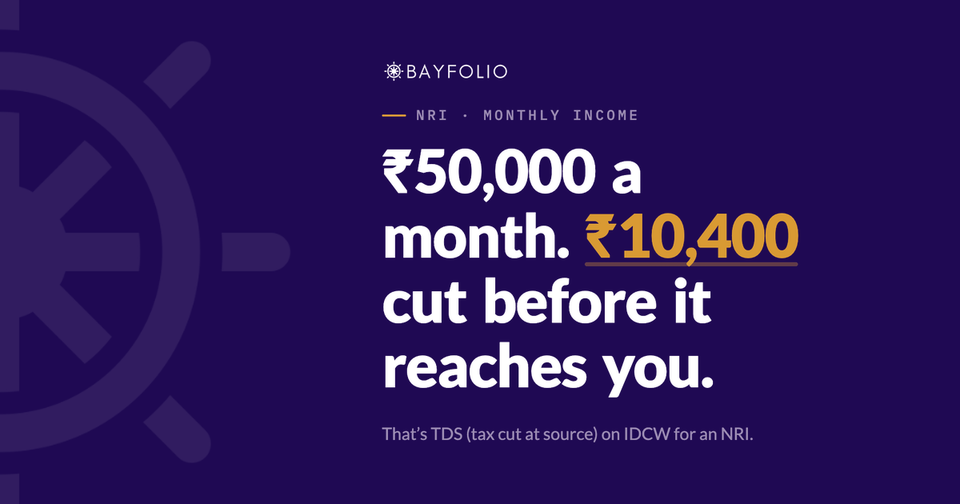
Many NRIs build a monthly income from mutual funds, for themselves or for parents in India. There are two common ways: the IDCW option, or an SWP. The tax cut at source is very different.
IDCW: TDS on every rupee
IDCW is the "dividend" option. For an NRI, TDS on IDCW is 20% plus 4% cess on every rupee paid. There is no threshold.
On ₹50,000 a month, ₹10,400 is cut before it reaches you. You receive ₹39,600.
You may have heard "there is no TDS up to ₹10,000 a year". That rule is for residents. It does not apply to NRIs.
SWP: TDS only on the gain part
With an SWP (systematic withdrawal plan), you sell a few units each month. Each withdrawal is mostly your own money coming back. Only the gain part is taxed.
For an NRI, TDS on an equity-oriented fund is cut on the gain, not the full amount:
- 20% on the gain from units held 12 months or less
- 12.5% on the gain from units held longer
- plus cess
The five-year gap
An illustration: ₹1 crore in an equity-oriented fund, ₹50,000 a month, NAV growing 10% a year.
| TDS cut | IDCW | SWP |
|---|---|---|
| Month 1 | ₹10,400 | ₹82 |
| Month 13 | ₹10,400 | ₹638 |
| Month 60 | ₹10,400 | ₹2,464 |
| Total over 5 years | ₹6,24,000 | ₹83,338 |
The SWP figures assume the ₹1.25 lakh yearly exemption is not applied at source. If the fund house does not apply it, you claim it in your Indian tax return.
TDS is not the final tax
TDS is tax collected in advance. Your Indian tax return settles the final amount, and any excess comes back as a refund.
A tax treaty (DTAA) can lower the TDS rate on IDCW. You need a Tax Residency Certificate and Form 41, given to the fund house before the payout. In practice, fund houses do not always apply it. Then you claim the difference in your return.
But even if the final tax evens out, the cash you receive each month differs. With IDCW, the refund comes only after you file.
Questions people ask
What is the TDS on mutual fund IDCW for NRIs?
Is TDS on an NRI's SWP cut on the full withdrawal?
Does the ₹10,000 TDS threshold on dividends apply to NRIs?
Is TDS the final tax for an NRI?
Compare both before you choose
For an NRI, the same ₹50,000 a month can arrive with very different deductions. Look at the TDS, not only the return.
Illustration: ₹1 crore in one equity-oriented fund, bought at once; NAV assumed to grow 10% a year, smoothly; ₹50,000 a month either way; IDCW of ₹50,000 a month assumed (IDCW is not guaranteed and lowers the NAV); total income under ₹50 lakh (no surcharge); units redeemed oldest first; the ₹1.25 lakh yearly exemption assumed not applied at source (it is then applied in your return). TDS rates for NRIs, tax year 2026-27: IDCW 20% plus surcharge (capped at 15%) and 4% cess, no threshold; redemption TDS on the gain at 20% (units held 12 months or less) or 12.5% (longer) for equity-oriented funds, plus surcharge and cess. Income-tax Act, 2025 s.393 (erstwhile s.195 and s.196A of the 1961 Act). General information only.
Mutual fund investments are subject to market risks. Read all scheme-related documents carefully. Past performance does not guarantee future returns. BayFolio LLP · AMFI-registered Mutual Fund Distributor · ARN-363035.
Member discussion