
Is your safe money losing value? Inflation in India, 2016 to 2025
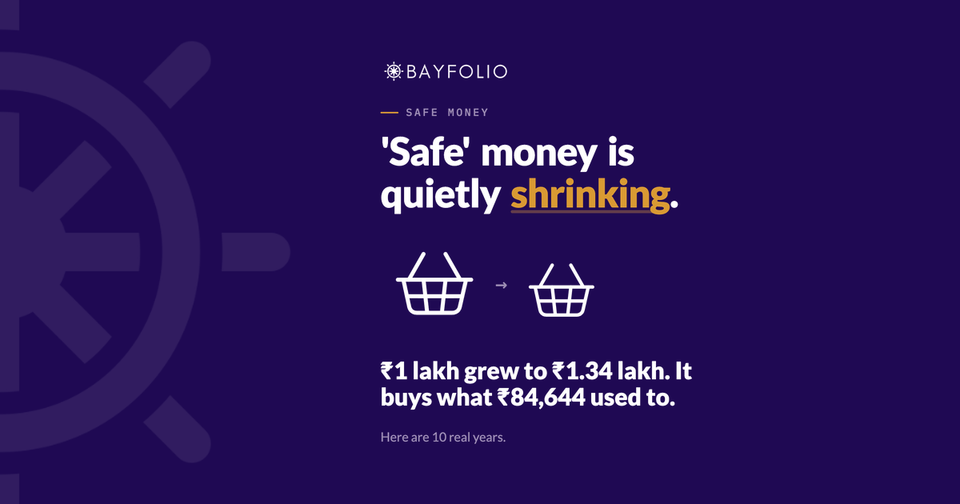
Money in a savings account feels safe. Its balance never falls. But what it can buy does.
Prices rose about 59% in ten years
From 2016 to 2025, prices in India rose about 59%. That is 4.7% a year on average.
| Year | Inflation |
|---|---|
| 2016 | 5.0% |
| 2017 | 3.3% |
| 2018 | 3.9% |
| 2019 | 3.7% |
| 2020 | 6.6% |
| 2021 | 5.1% |
| 2022 | 6.7% |
| 2023 | 5.7% |
| 2024 | 5.0% |
| 2025 | 2.4% |
What happened to ₹1 lakh
Say you kept ₹1 lakh in an account earning an assumed 3% a year, from 2015.
| Amount | |
|---|---|
| Your statement in 2025 | ₹1,34,392 |
| What it buys, at 2015 prices | ₹84,644 |
The balance went up. The buying power went down by about 15%.
The catch: what's left after prices rise
What counts is your real return: the interest rate minus inflation.
3% interest minus 4.7% inflation is about −1.7% a year in buying power.
The honest part
- Cash still has a job. Your emergency money belongs somewhere safe and easy to reach. Losing a little to prices is the cost of that safety.
- Inflation is an average. Your own costs, like school fees or medical bills, may rise faster or slower.
- Growth assets have beaten inflation over long periods. Not every year.
Questions people ask
What was India's inflation rate from 2016 to 2025?
Does keeping money in a savings account lose value?
What is real return?
How much money should I keep in cash?
Let long-term money outgrow prices
Keep safe money for safe jobs. Give long-term money a chance to beat inflation.
Illustration: interest assumed at 3% a year, compounded yearly, before tax. Inflation: World Bank, "Inflation, consumer prices (annual %)", India, 2016–2025. Prices rose 58.8% over the 10 years (4.73% a year on average).
Mutual fund investments are subject to market risks. Read all scheme-related documents carefully. Past performance does not guarantee future returns. BayFolio LLP · AMFI-registered Mutual Fund Distributor · ARN-363035.
Member discussion