
Direct vs regular mutual funds: what the difference costs you
Mutual fund investments are subject to market risks, read all scheme related documents carefully.
1. Two plans, one fund
Every mutual fund scheme has two plans: direct and regular. Both hold the same shares and bonds, with the same fund manager. Only the cost is different.
You buy a direct plan yourself, from the fund house or a direct platform. You buy a regular plan through a mutual fund distributor, like BayFolio. The fund house pays the distributor a yearly commission out of the regular plan’s costs. So the regular plan has a higher expense ratio, and its NAV grows a little slower.
Many bank apps also sell regular plans, but without a review or a call when markets fall. So the question is not only which plan, but what you get for the extra cost.
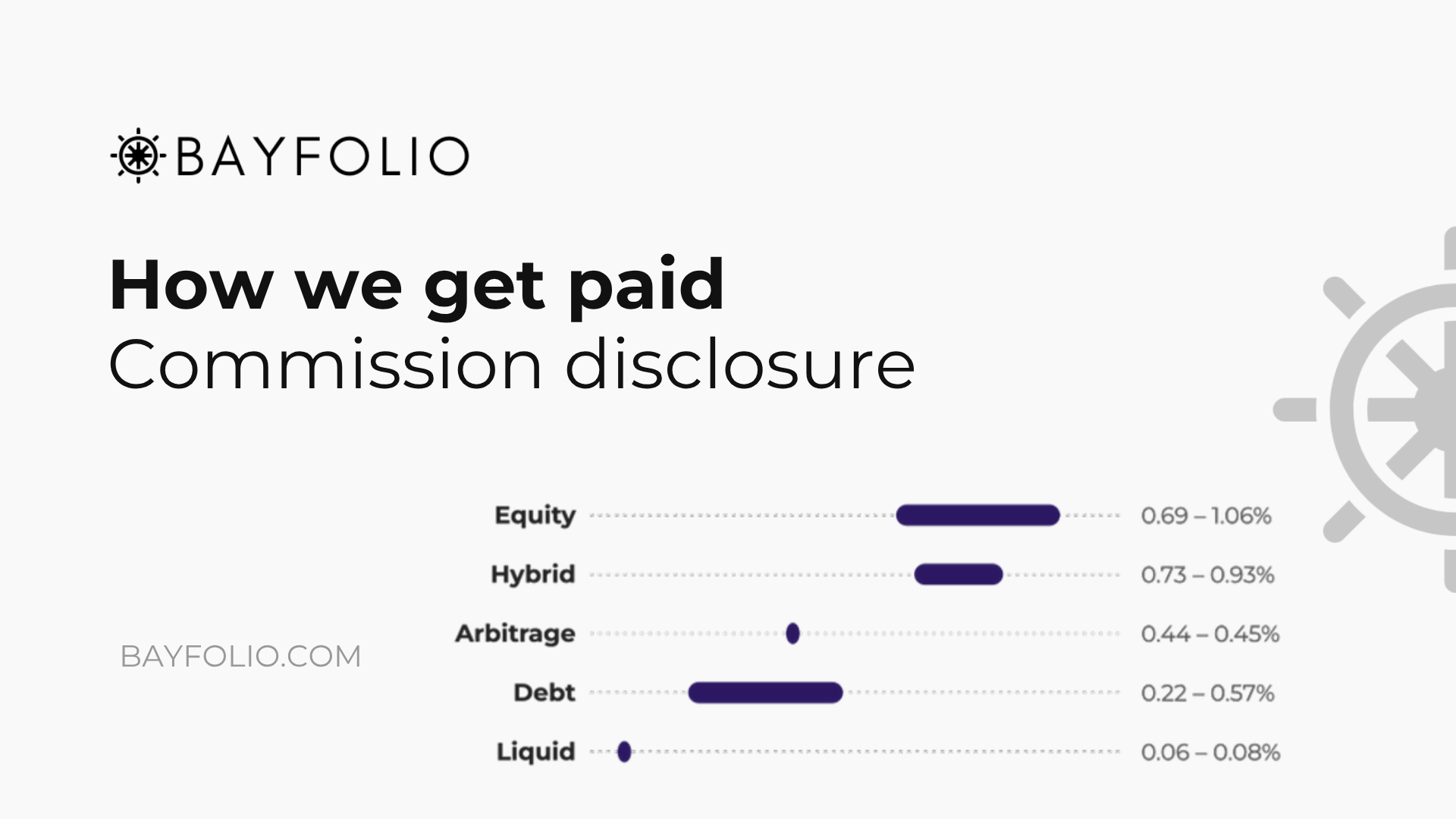
BayFolio offers regular plans. See what we earn from every fund house →
2. Side by side
| Direct plan | Regular plan | |
|---|---|---|
| Investments and fund manager | Same | Same |
| Yearly cost | Lower | Higher, by our commission (see rates) |
| Fee to anyone else | None, unless you pay a SEBI-registered investment adviser | None. We are paid only by the fund house. |
| Choosing funds | You do it | We shortlist with you, based on your goal, time and risk |
| Reviews | You do them | Once a year, and when markets or your life change |
| Paperwork | You do it: KYC, FATCA, nominees, bank changes | We prepare it and follow up with the fund house |
| NRI matters | You track NRE and NRO rules, tax deducted at source and repatriation | We help you keep each account and folio in order |
| When markets fall | You decide alone | You can call us before you act |
| Where your money goes | From your bank to the fund house, in your name | Same. We never hold it. |
3. What the difference costs you
A small yearly cost adds up over many years. Here is a plain example.
Say you invest ₹10 lakh once. The fund grows by 10% a year before our commission. The regular plan costs 0.75% a year more than the direct plan. So the direct plan grows by 10% and the regular plan by 9.25%.
₹10 lakh invested once, value in ₹ lakh
| After | Direct plan | Regular plan | Difference | Difference as % of direct |
|---|---|---|---|---|
| 1 year | ₹11.0 lakh | ₹10.9 lakh | ₹7,500 | 0.7% |
| 3 years | ₹13.3 lakh | ₹13.0 lakh | ₹0.3 lakh | 2.0% |
| 5 years | ₹16.1 lakh | ₹15.6 lakh | ₹0.5 lakh | 3.4% |
| 7 years | ₹19.5 lakh | ₹18.6 lakh | ₹0.9 lakh | 4.7% |
| 10 years | ₹25.9 lakh | ₹24.2 lakh | ₹1.7 lakh | 6.6% |
After 10 years, the regular plan ends up about ₹1.7 lakh lower. That is the true cost of the regular plan in this example. It is more than 0.75% × 10 years, because the cost compounds.
The regular plan is worth it only if our work is worth more to you than this gap. For example: a better fund choice for your goal, staying invested in a bad year, a correct tax and NRI setup, and no missed paperwork. We cannot promise any of these will add returns. Judge us on what we actually do for you.
Assumptions: one investment, growth of 10% a year before costs, a 0.75% yearly gap, no tax, no withdrawals. 10% is used only to make the maths easy. It is not a forecast, and funds can fall in value. The real gap for a scheme is the difference between its regular and direct expense ratios, which each fund house publishes on its website.
4. Which plan suits you
A direct plan may suit you if
- you can pick funds without following last year’s returns
- you review your portfolio yourself, at least once a year
- you stay calm and invested when markets fall
- you handle KYC, nominee, bank and tax paperwork yourself
- you would rather keep the cost than pay for help
A regular plan through us may suit you if
- you want someone to check each choice against your goal
- you live abroad and want your NRI paperwork kept in order
- you want a yearly review without having to ask for it
- you want someone to call before you sell in a bad market
- you would rather pay a small yearly cost than do it all yourself
Both are good choices for the right person. A direct plan with no reviews can cost more in mistakes than it saves. A regular plan with no real service is not worth its cost.
5. Moving from regular to direct
You can move to a direct plan at any time. Before you do, know this:
- A switch from a regular plan to a direct plan counts as a sale for income tax. You may pay capital gains tax on the gain.
- An exit load may apply if you have held the units for a short time. Check the scheme’s exit load first.
- If you are an NRI, tax is deducted at source on the gain at the time of the switch.
- The units you get in the direct plan start a new holding period.
So a switch can cost more this year than the commission it saves. Work out both numbers before you move.
6. Questions
Is a direct plan or a regular plan better?
It depends on what you need. A direct plan suits you if you will do the work yourself: choosing funds, reviewing them and keeping the paperwork in order. What a direct plan cannot give you is a calm voice when markets fall and you want to sell. That is the part people value most in a regular plan.
Will a regular plan give me better returns?
No. The same fund in a regular plan returns a little less, by the commission. You pay for help with choices, reviews and paperwork, not for higher returns.
Isn’t commission a conflict of interest?
It can be, so here is how we choose. We first pick funds on their risk-adjusted returns over time. Only when two funds are the same on that, year after year, do we look at the commission. Then we pick the one that pays us more. Every rate we earn is on our commission page, and we have no sales targets.
Is the fund manager different in a direct plan?
No. Both plans are the same fund, run by the same manager, with the same investments.
Where can I see the expense ratio of both plans?
On the fund house’s website, on each scheme’s page. The difference between the two is the yearly cost gap.
How much does BayFolio earn on a regular plan?
It depends on the fund house and the fund type. See our commission disclosure.
Can BayFolio put me in direct plans?
No. We offer regular plans only. If you want direct plans, you can invest through the fund house’s website or a direct platform.
Can I move from a direct plan to a regular plan?
Yes. A switch between plans counts as a sale for income tax, so check the gain and any exit load first. If you are an NRI, tax is deducted at source on the gain at the time of the switch.
Can you review the direct plans I already hold?
Yes, as part of your yearly review. We will tell you if a switch makes sense and what the tax would be. We do not move money without your instruction.
Is my money held in my name?
Yes. It goes from your bank straight to the fund house, in your name. We never hold it.
 BayFolio LLP
Last updated: 9 November 2026
This page is information only. It is not a recommendation to buy or sell any fund. Past performance does not guarantee future returns. Mutual fund investments are subject to market risks, read all scheme related documents carefully.